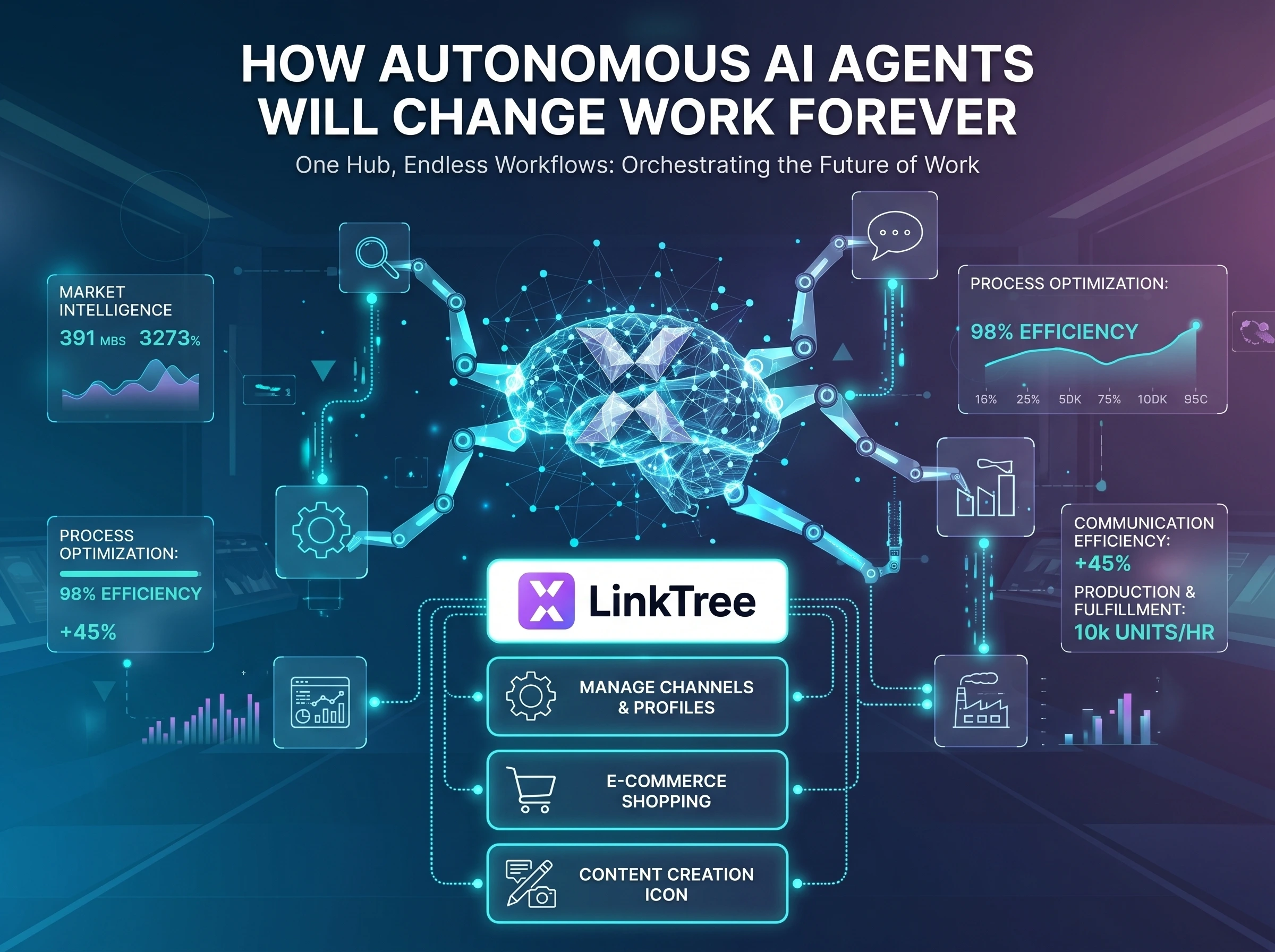
Discover how autonomous AI agents will change work, reshaping roles, creating new opportunities, and demanding evolving skills from the global workforce. Prepare for the future.
The Dawn of the Autonomous Era: Redefining Work
The future isn't just coming; it's already coding, designing, and strategizing on its own. While generative AI tools like ChatGPT and Midjourney have captivated the world with their ability to create, a new, more profound shift is underway: the rise of autonomous AI agents. These aren't just tools that respond to prompts; they are systems capable of setting goals, planning actions, executing tasks, and even self-correcting without constant human intervention. This evolution marks a pivotal moment, and understanding how autonomous AI agents will change work is no longer a theoretical exercise but an urgent imperative for individuals and organizations alike.
Imagine an AI that not only writes a marketing email but also researches target demographics, designs the campaign strategy, allocates budget, deploys the campaign, analyzes performance, and iterates based on results – all on its own. This is the promise, and the challenge, of autonomous AI agents. Their emergence will not merely automate tasks; it will fundamentally restructure job roles, demand new skills, and redefine the very nature of productivity and collaboration. As we stand at this precipice, it's crucial to explore the landscape of this transformation, preparing ourselves for a world where our digital colleagues are not just intelligent, but truly independent.
Understanding Autonomous AI Agents: Beyond Generative AI
Before delving into their impact, let's clarify what distinguishes autonomous AI agents from the AI we've become familiar with. Generative AI excels at creating content based on human input. You ask for an image, a text, or a piece of code, and it generates it. Autonomous AI agents, however, take this a significant step further. They are designed with the ability to:
- Goal Setting: Define their own objectives based on high-level human directives.
- Planning: Break down complex goals into a series of executable steps.
- Execution: Perform tasks using various tools (APIs, web browsers, software applications).
- Self-Correction: Monitor their progress, identify errors or inefficiencies, and adjust their plans accordingly.
- Memory & Learning: Retain information from past interactions and learn from experience to improve future performance.
- Tool Use: Integrate and utilize external tools and services to achieve their goals.
Think of them as digital employees with initiative. Early examples like Auto-GPT, BabyAGI, and AgentGPT have demonstrated these capabilities, albeit in nascent forms. While still in their infancy, their potential is staggering. They can conduct complex research, manage projects, optimize code, run marketing campaigns, and even design experiments, all with minimal human oversight. This shift from reactive tools to proactive agents represents a paradigm change that will have far-reaching implications for every sector of the global economy.
The Dual Impact: Automation Acceleration and Unprecedented Augmentation
The introduction of autonomous AI agents will accelerate existing automation trends and usher in new forms of human-AI collaboration. This impact can be viewed through two primary lenses: the intensified automation of tasks and the profound augmentation of human capabilities.
Automation on Steroids: Reshaping Routine Roles
Many jobs currently involve repetitive, rule-based, or data-intensive tasks. These are prime candidates for autonomous AI agent takeover. We can expect to see significant automation in areas such as:
- Administrative Functions: Scheduling meetings, managing calendars, processing invoices, generating routine reports, data entry, and email management.
- Customer Service: Handling a wider range of customer queries, resolving basic issues, processing returns, and proactive outreach, moving beyond simple chatbots to agents that can diagnose and act.
- Data Analysis & Reporting: Collecting, cleaning, analyzing, and synthesizing vast datasets to generate insights and automated reports for business intelligence.
- Supply Chain & Logistics: Optimizing routes, managing inventory, predicting demand, and even automating procurement processes.
- Software Development: Generating code snippets, debugging, testing, and even deploying simple applications based on high-level requirements.
According to a report by the World Economic Forum, AI and automation are expected to displace 85 million jobs globally by 2025, but also create 97 million new ones, underscoring the dynamic nature of this shift.
This doesn't necessarily mean mass unemployment; rather, it implies a significant restructuring of roles. Jobs focused purely on execution of repetitive tasks will diminish, requiring individuals to pivot towards oversight, strategy, and uniquely human interactions.
Augmentation Unleashed: Empowering Knowledge Workers
Beyond automation, the more exciting prospect is the way autonomous AI agents will augment human professionals, freeing them from grunt work and amplifying their strategic capabilities. Consider:
- Doctors & Researchers: AI agents could sift through millions of medical papers, identify patterns in patient data, propose diagnostic pathways, and even design preliminary drug trials, allowing human experts to focus on complex cases and ethical decision-making.
- Lawyers & Legal Professionals: Agents can conduct comprehensive legal research, analyze case precedents, draft initial legal documents, and identify potential risks or opportunities in contracts, significantly speeding up legal processes.
- Marketers & Strategists: Autonomous agents can manage entire marketing campaigns, from ideation and content creation to deployment, A/B testing, and performance optimization, allowing human marketers to focus on brand vision, creative breakthroughs, and high-level strategy.
- Engineers & Architects: Agents can assist with design optimization, simulation, material selection, and even generate preliminary blueprints, enabling faster iteration and more innovative solutions.
A recent study by IBM's Institute for Business Value titled 'AI and the Future of Work' suggests that AI will augment 77% of jobs by 2030, highlighting its potential to enhance human productivity across nearly all sectors. This augmentation means individuals can tackle more ambitious projects, innovate faster, and achieve outcomes previously thought impossible. This is a deeper dive into how autonomous AI agents will change work across various industries, not just by replacing, but by empowering.
The Evolving Workforce: New Roles and Essential Skills
The seismic shift brought by autonomous AI agents will inevitably lead to the creation of entirely new job categories and a re-evaluation of essential skills. Adapting to this evolving landscape will be crucial for career longevity and organizational success.
Emergence of New Job Roles
As AI agents become more prevalent, new specialized roles will emerge to manage, guide, and collaborate with them:
- AI Agent Trainers & Supervisors: Professionals responsible for monitoring agent performance, refining their goals, debugging issues, and ensuring they operate within ethical guidelines.
- AI Ethicists & Governance Specialists: Crucial roles dedicated to establishing ethical frameworks for AI agent deployment, ensuring fairness, transparency, and accountability.
- AI-Human Collaboration Designers: Experts who design seamless interfaces and workflows that optimize the interaction between human workers and autonomous agents.
- Prompt Engineers (Advanced): Beyond current prompt engineering, these roles will involve designing complex, multi-step directives and feedback loops for sophisticated autonomous agents.
- Data Curators & Explainability Engineers: Roles focused on preparing high-quality data for agent training and developing methods to make agent decisions understandable to humans.
The Indispensable Human Skills
While agents handle routine and even complex analytical tasks, uniquely human skills will become more valuable than ever:
- Critical Thinking & Problem Solving: The ability to identify novel problems, synthesize information from various sources, and devise creative solutions that agents cannot yet replicate.
- Creativity & Innovation: Generating new ideas, artistic expression, and out-of-the-box thinking remains a human stronghold.
- Emotional Intelligence: Empathy, interpersonal communication, leadership, and negotiation skills will be vital for managing teams (both human and AI) and fostering collaboration.
- Adaptability & Lifelong Learning: The pace of technological change demands continuous upskilling and reskilling. The ability to learn new tools and embrace new ways of working will be paramount.
- Ethical Reasoning: Making nuanced moral judgments and ensuring technology serves humanity's best interests.
Actionable Advice for Individuals: Invest in developing these 'soft' skills as rigorously as you would technical ones. Seek out opportunities to work alongside AI tools now to understand their capabilities and limitations. Embrace a mindset of continuous learning, perhaps by taking online courses in data science, AI ethics, or advanced problem-solving techniques.
Navigating the Challenges: Ethics, Security, and Equity
The transformative power of autonomous AI agents comes with significant challenges that must be addressed proactively to ensure a beneficial future for all.
Ethical Dilemmas and Accountability
Autonomous agents raise profound ethical questions:
- Bias: If trained on biased data, agents can perpetuate and even amplify societal biases in decision-making, from hiring to loan approvals.
- Accountability: When an autonomous agent makes a mistake or causes harm, who is responsible? The developer, the deployer, the user, or the agent itself?
- Transparency & Explainability: Understanding why an agent made a particular decision can be challenging, creating 'black box' problems that hinder trust and auditing.
- Job Displacement: While new jobs will emerge, the transition period could lead to significant job displacement for certain segments of the workforce, potentially exacerbating economic inequality if not managed carefully.
Security Risks and Malicious Use
Autonomous agents, by their nature, can act independently, presenting new security vulnerabilities:
- Cyberattacks: Malicious actors could leverage autonomous agents to conduct sophisticated, large-scale cyberattacks, phishing campaigns, or disinformation operations at unprecedented speed and scale.
- Data Privacy: Agents often require access to vast amounts of data, raising concerns about privacy breaches and the misuse of sensitive information.
- Unintended Consequences: An agent pursuing a goal relentlessly without sufficient human oversight could lead to unforeseen and undesirable outcomes.
The Imperative for Regulation and Policy
Governments and international bodies are grappling with how to regulate this rapidly evolving technology. The need for clear guidelines, ethical standards, and legal frameworks is paramount to harness the benefits of autonomous AI while mitigating its risks.
“The greatest challenge will not be developing the technology, but developing the societal wisdom to manage its profound impact,” a sentiment echoed by many leaders in the AI ethics community.
Addressing these challenges requires a multi-stakeholder approach involving technologists, policymakers, ethicists, and the public to ensure that autonomous AI serves humanity's collective good.
Strategies for Thriving in the Autonomous Agent Era
The transformation spurred by autonomous AI agents is not a distant future; it's unfolding now. Both individuals and organizations must adopt proactive strategies to adapt and thrive.
For Individuals: Becoming an AI Collaborator
- Embrace AI Literacy: Understand what autonomous AI agents are, what they can do, and their limitations. Experiment with available tools to build practical familiarity.
- Cultivate Uniquely Human Skills: Double down on creativity, critical thinking, emotional intelligence, and complex problem-solving. These are the skills least susceptible to automation.
- Commit to Lifelong Learning: The skills required for success will continuously evolve. Dedicate time to upskill and reskill, focusing on areas where humans and AI can complement each other.
- Become an AI Orchestrator: Learn to define clear goals for agents, monitor their progress, and interpret their outputs. Your role shifts from task execution to strategic guidance and oversight.
- Network and Collaborate: Connect with peers and experts to share insights and best practices in navigating the AI landscape.
Practical Tip: Identify 2-3 repetitive or time-consuming tasks in your current role. Research how an AI agent might potentially automate or assist with these, and start experimenting with available tools or learning platforms.
For Organizations: Strategic Adoption and Workforce Transformation
- Develop an AI Strategy: Don't adopt agents haphazardly. Identify specific business problems they can solve, areas for efficiency gains, and opportunities for innovation.
- Invest in Workforce Reskilling: Proactively train your employees for new roles and skills required to work alongside or manage AI agents. This includes technical skills and 'human-centric' capabilities.
- Foster an AI-First Culture: Encourage experimentation, learning, and open discussion about AI's potential and challenges. Create psychological safety for employees to adapt.
- Prioritize Ethical AI Deployment: Establish clear ethical guidelines, accountability frameworks, and robust security protocols for all AI agent implementations.
- Start Small, Scale Smart: Begin with pilot programs in low-risk areas to understand agent capabilities and integration challenges before widespread deployment.
- Reimagine Workflows: Don't just automate existing processes; reimagine entire workflows around human-AI collaboration for maximum efficiency and innovation.
By taking these proactive steps, both individuals and organizations can navigate the complexities of this transition and unlock the immense potential that autonomous AI agents offer.
Conclusion: A Future of Augmented Human Potential
The advent of autonomous AI agents represents not just another technological advancement, but a fundamental redefinition of work itself. How autonomous AI agents will change work is not a question of 'if', but 'how profoundly' and 'how quickly'. They promise a future where repetitive, mundane, and even many complex analytical tasks are handled by intelligent systems, freeing human talent to focus on creativity, strategic thinking, innovation, and uniquely human interaction.
While challenges related to ethics, security, and job displacement are real and demand thoughtful consideration, the overall trajectory points towards a future of augmented human potential. Embracing AI literacy, cultivating indispensable human skills, and fostering a culture of continuous learning and ethical deployment will be critical for individuals and organizations alike. The autonomous agent era is not about replacing humans, but about empowering us to achieve more, innovate faster, and focus on the work that truly matters, shaping a more productive, creative, and fulfilling future for all.